Video mapTokyo12 spots
Georgene Loh in Tokyo: 12 Spots From the Video
12 spots in Tokyo, mapped from 13 Japan coffee shops you should visit pt.2 by Georgene Loh.
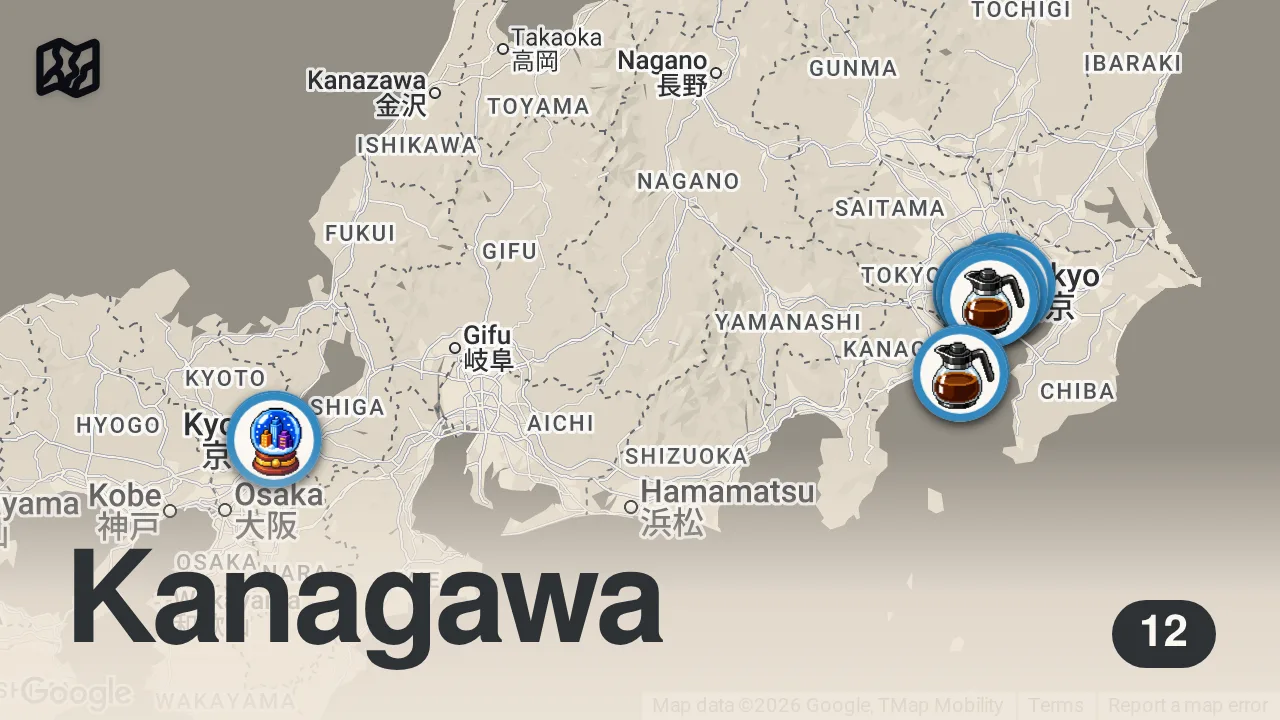
The 12 spots

Ogawa Coffee Laboratory Shimokitazawa
- Ogawa Coffee Laboratory ShimokitazawaThe undisputed capital of vintage and thrift shopping in Tokyo. This neighborhood is a labyrinth of narrow, pedestrian-friendly streets packed with independent boutiques like Flamingo and Chicago.
Japan, 〒155-0031 Tokyo, Setagaya City, Kitazawa, 3-chōme−19−20 reload1-1

Tokyo
Tokyo, Japan

Kyoto
Kyoto, Japan
Idobata
2-chōme-14-13 Hase, Kamakura, Kanagawa 248-0016, Japan
nadoya no katte
3-chōme-19-3 Nishihara, Shibuya, Tokyo 151-0066, Japan
Kamakura
Kamakura, Kanagawa, Japan
ignis
3-chōme-44-11 Sendagi, Bunkyo City, Tokyo 113-0022, Japan
Leaves Coffee Roasters
1-chōme-8-8 Honjo, Sumida City, Tokyo 130-0004, Japan
Show all 12 spots

Style Coffee
360-1 Masuyachō, Kamigyo Ward, Kyoto, 602-0877, Japan
WOODBERRY COFFEE SHIBUYA
2-chōme-20-18 Higashi, Shibuya, Tokyo 150-0011, Japan
Onibus Coffee
2-chōme-14-1 Kamimeguro, Meguro City, Tokyo 153-0051, Japan
Cafe de l'ambre
8-chōme-10-15 Ginza, Chuo City, Tokyo 104-0061, Japan
From the video
 13 Japan coffee shops you should visit pt.2 · Georgene Loh
Georgene Loh was particularly moved by the Idopata Coffee Stand, where she enjoyed a top-tier Guatemala Gisha pourover served from a vintage van by a passionate former bookseller. She highlighted the deep respect for craft and intention found across Japan's coffee scene, from traditional cloth-filter brewing to modern, minimal spaces.
Food from the video
 Hot white with Brazilian beans
 Guatemala Gisha pourover
 Kamakura latte with matcha nuances
 Straight black coffee (cloth filter)
 Latte with Colombia beans
 Pourover with Ecuador beans
 Hot white (Onibus Coffee)
 Espresso drink (Kyoto Style Coffee)
Researched by Varedelo
Planning notes for Tokyo
 Must-try foods in Tokyo
- Edomae SushiThe quintessential Tokyo sushi style, originating from the Edo period when fish was 'treated' (cured or simmered) to preserve it. In 2026, the trend leans toward 'Cospa' (cost-performance) omakase where world-class nigiri, like fatty tuna (otoro) and sea urchin (uni), is served in intimate 10-12 seat counters across Ginza and Nishi-Azabu.
- MonjayakiTokyo's answer to okonomiyaki, this savory pancake is a specialty of the Tsukishima district. It has a much runnier, liquid consistency and is eaten directly off the grill with a tiny spatula. Modern versions in 2026 feature 'neo' toppings like mentaiko (spicy cod roe), mochi, and even Italian-inspired cheeses.
- YakitoriSkewered chicken grilled over binchotan charcoal. While classic thigh and green onion (negima) are essential, Tokyo locals in 2026 frequent specialized 'nose-to-tail' yakitori dens that serve rare cuts like 'chochin' (unlaid egg with fallopian tube) and 'soriles' (chicken oysters).
- Edo-style SobaBuckwheat noodles are a historical Tokyo fast food. In 2026, the city sees a resurgence of artisanal 'Te-uchi' (hand-pulled) soba shops. Locals often prefer the cold 'Zaru Soba' to appreciate the nutty flavor of the buckwheat, ending the meal by mixing the leftover dipping sauce with 'sobayu' (hot noodle water).
- AnpanA classic Japanese sweet roll filled with red bean paste (anko). The most iconic version is found at Ginza Kimuraya, which has been using a unique liquid yeast made from rice malt (sakadane) since 1874. It remains a must-eat snack for anyone walking through central Tokyo.
- TempuraLightly battered and deep-fried seafood and vegetables. Tokyo's high-end tempura culture emphasizes seasonality; in 2026, expect trending ingredients like sea urchin wrapped in shiso leaf or rare 'sweetfish' (ayu) to be served piece-by-piece in specialized tempura-ya.
Trip guide
- About TokyoTokyo is the capital of Japan and serves as the country’s political and economic center. Historically, the city originated as a small fishing village known as Edo before becoming the seat of the Tokugawa shogunate in 1603. This period established the urban layout that informs the modern city, with the Imperial Palace—formerly Edo Castle—occupying the central geographic position.
- When to goThe best times to visit Tokyo are spring (late March to April) for cherry blossoms and autumn (October to November) for vibrant foliage and mild, pleasant temperatures. While summer is hot and humid with frequent rain, winter offers crisp, sunny days and fewer crowds, though temperatures can drop significantly. Peak tourist seasons coincide with the spring blooms and the Golden Week holidays in early May.
- Getting around Tokyo
- International Air Travel (Narita and Haneda) Most travelers arrive via Narita International Airport (NRT) or Haneda Airport (HND). Haneda is closer to the city center, while Narita is connected by the high-speed Narita Express or the Keisei Skyliner train services.
- Tokyo Subway and JR Train Network The city is navigated using an extensive grid of JR lines, like the Yamanote loop, and Tokyo Metro subways. Using a rechargeable IC card like Suica or Pasmo allows for seamless tap-and-go entry across all different.
- Shinkansen (Bullet Train) For those arriving from other Japanese cities like Osaka or Kyoto, the Shinkansen high-speed rail terminates at Tokyo or Shinagawa stations, providing a fast and punctual alternative to domestic flights.
- Local tips
- Download a digital Suica or Pasmo card to your smartphone for seamless tap-and-go travel on all subways, trains, and buses.
- Carry a small bag for your own trash, as public garbage cans are extremely rare and littering is strictly avoided.
- Refrain from talking on your phone or speaking loudly while using public transportation to respect the local culture of quiet commuting.
- What’s new in Tokyo
- PokéPark Kanto: The world's first permanent outdoor Pokémon theme park opening in February 2026 at Yomiuriland.
- Edo-Tokyo Museum Reopening: A major cultural event in March 2026 following a four-year renovation of this iconic history museum.
 Visit KamakuraVisit KamakuraThe official tourism website for Kamakura City, managed by the Kamakura City Tourist Association to provide travel guides, maps, and event information.
Planning questions
Where did Georgene Loh eat in Tokyo?
This guide maps all 12 spots featured in the video, with names, addresses, and neighborhoods, so you can plan where to eat in Tokyo.
What are the must-try foods in Tokyo?
Creator picks from the video include Hot white with Brazilian beans, Guatemala Gisha pourover, Kamakura latte with matcha nuances, Straight black coffee (cloth filter). Open the map in Varedelo to see which spot each one is at.
Can I save these spots to use on my trip?
Yes. Open the map in Varedelo to save every spot, get directions, and revisit the guide from your phone while you travel.